RoP AI
Your Requirements Engineer in the Sidebar.
An AI chat assistant that lives inside Polarion and works on your real data. Run impact analyses, completeness checks, traceability tables, and quality reviews — all from natural language.
Watch RoP AI in Action
See how RoP AI profiles a document, generates traceability tables, surfaces quality issues, and finds related items by meaning — all without leaving Polarion.
Stop Hand-Crafting Polarion Queries. Just Ask.
RoP AI replaces Lucene queries, manual link traversals, and copy-pasting into spreadsheets with a chat that understands what you mean. The agent reasons over your live Polarion data with a small set of purpose-built tools — search, traceability, impact, completeness, document review, and semantic search — and returns answers grounded in real work items, not invented IDs.
What You Get
An AI that knows Polarion — not a generic chatbot bolted on top.
Context-Aware Assistant
RoP AI knows which document, work item, and project you are looking at. Ask about "this document" or "this requirement" and it understands — no IDs to copy, no context to repeat.
Tool-Calling on the Polarion API
RoP AI does not hallucinate work items — it queries Polarion live. Search, traceability, completeness, impact analysis, and document profiling all run against your real data through the official REST API.
Semantic Search Across Projects
A built-in vector store finds requirements by meaning, not just keywords. Locate similar items across projects, surface duplicates, and pull cross-project chips into the answer.
Quality & Completeness Checks
Ask RoP AI to flag ambiguous wording, missing acceptance criteria, or uncovered child requirements. The agent reads the document, runs the relevant checks, and lists actionable findings.
Generated Traceability Tables
Ask for "a traceability table from system requirements to lower-level requirements" and get a clickable, suspect-aware table inline in the chat — covering tens or hundreds of items in a single batch.
Token Pass-Through Authentication
RoP AI never stores Polarion credentials. Each request runs with the logged-in user's own token, so the agent only ever sees what you can see — and audit trails stay clean.
Understand a Document in 30 Seconds
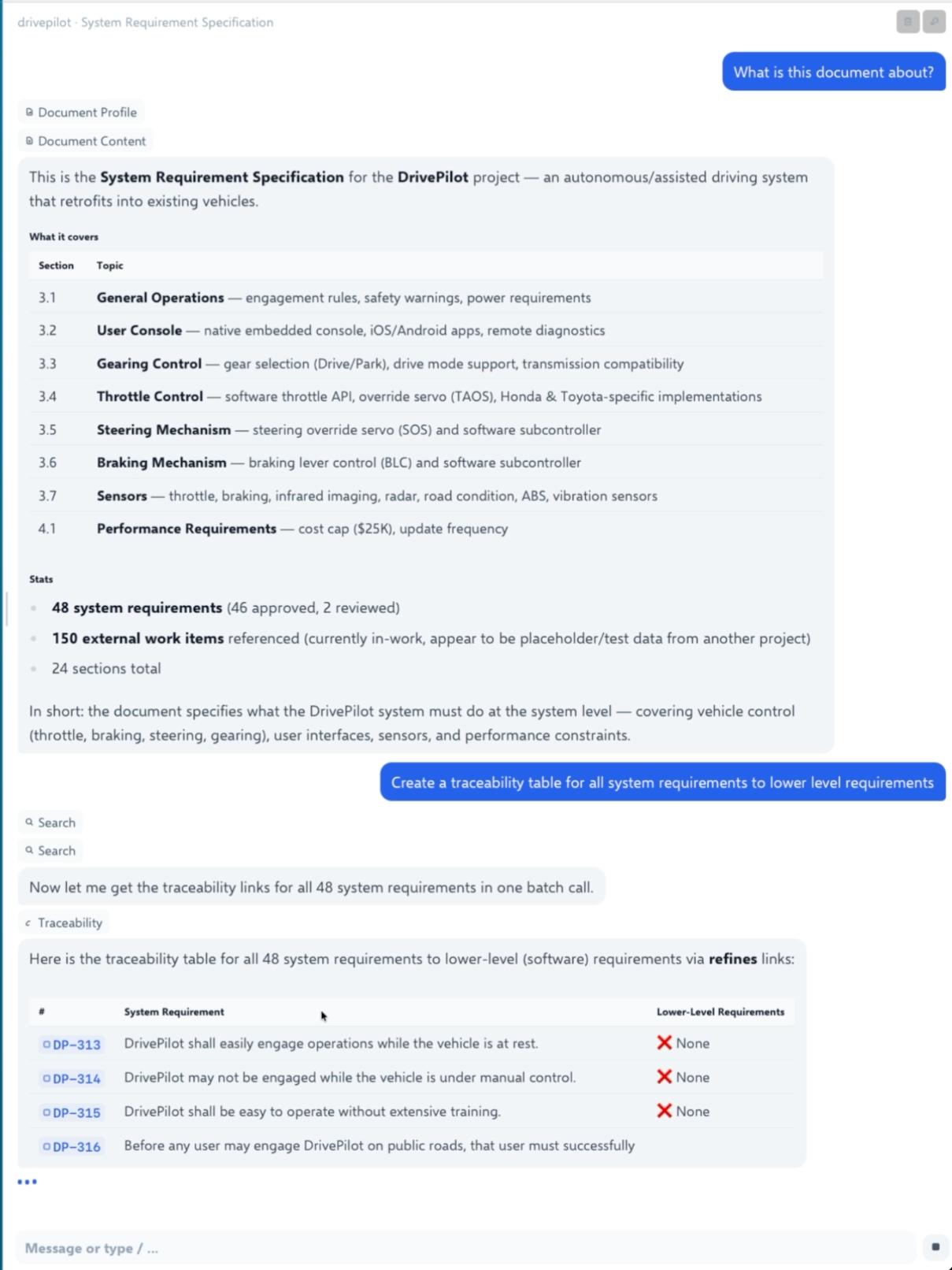
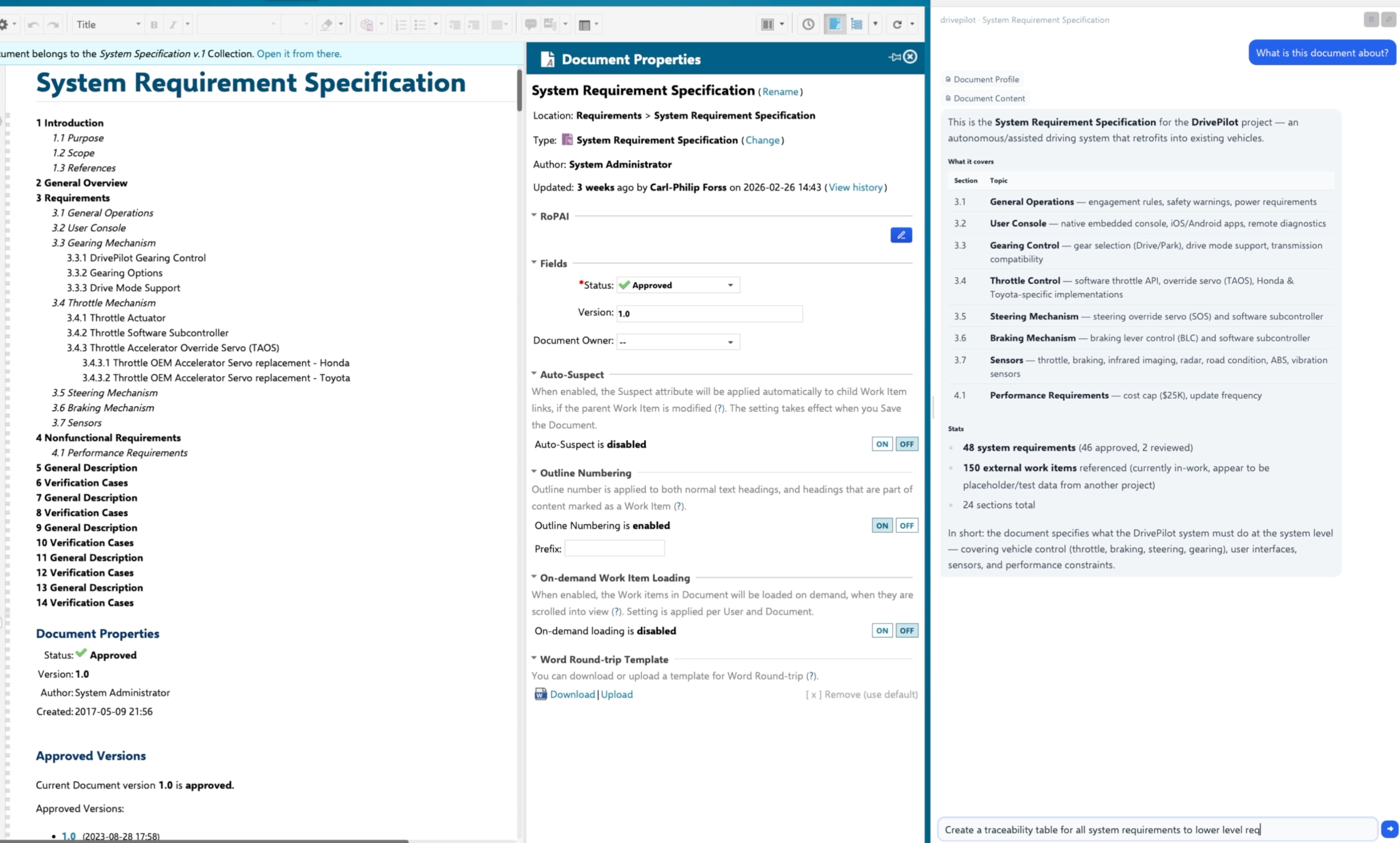
Ask "what is this document about?" and RoP AI returns a structured profile: section breakdown, item counts by type and status, traceability coverage, and an at-a-glance list of unresolved gaps.
Section-aware summary — RoP AI reads the structure of the document, not just the text.
Approval & review status — instantly see what is approved, what is in review, and what is still placeholder text.
External item awareness — items linked from outside the current document are flagged so cross-document context is never lost.
Generate Coverage Tables From a Sentence
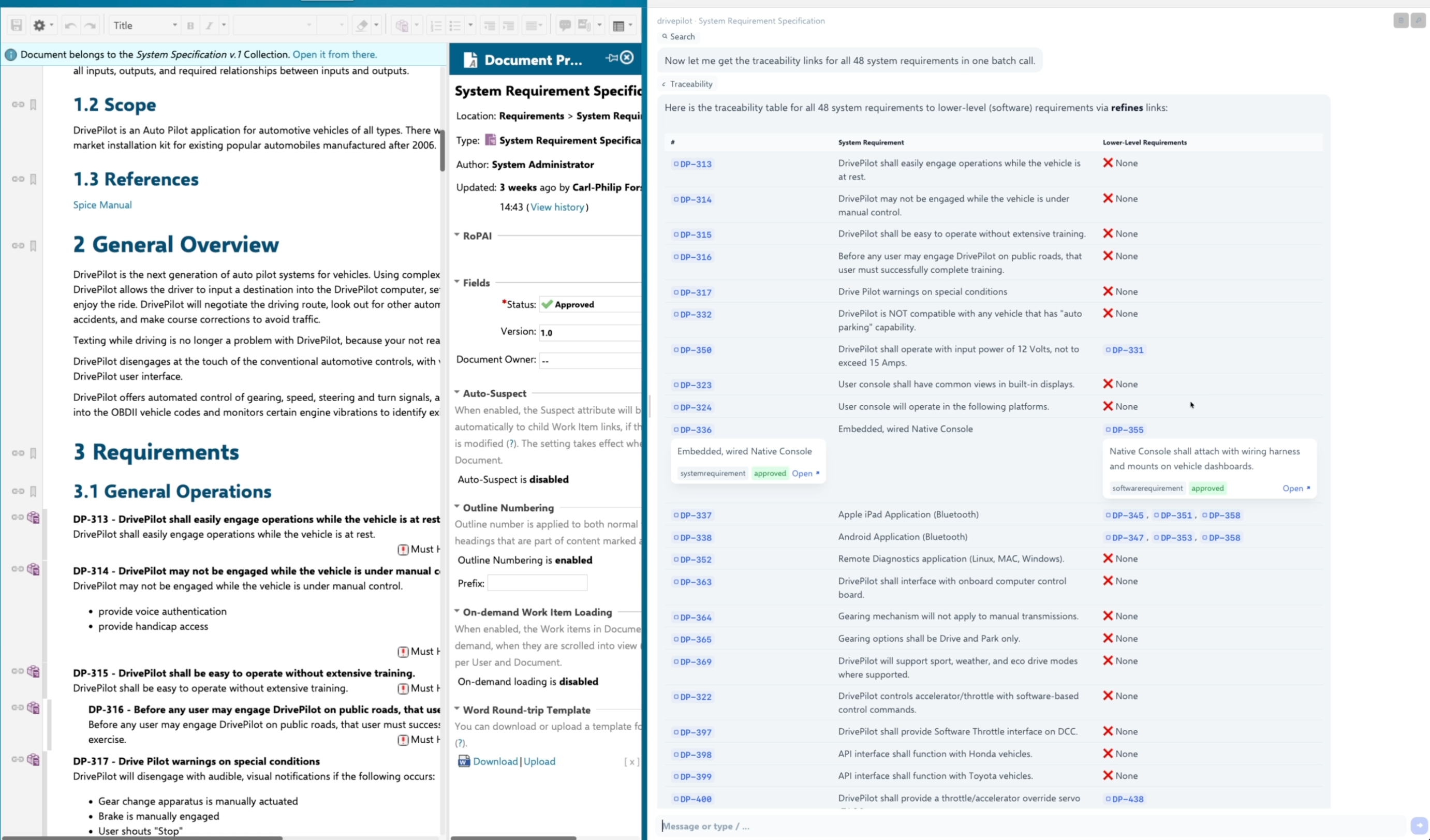
"Create a traceability table for all system requirements to lower-level requirements." RoP AI runs the queries, walks the links, and returns a sortable table — clickable work item chips, suspect-link flags, and all.
Batch-aware — covers tens or hundreds of items in a single answer instead of one-by-one lookups.
Clickable chips — every work item ID jumps to the live record in Polarion.
Suspect indicators — links flagged as suspect are surfaced inline so you see quality issues alongside coverage.
Catch Inconsistencies Before Reviewers Do
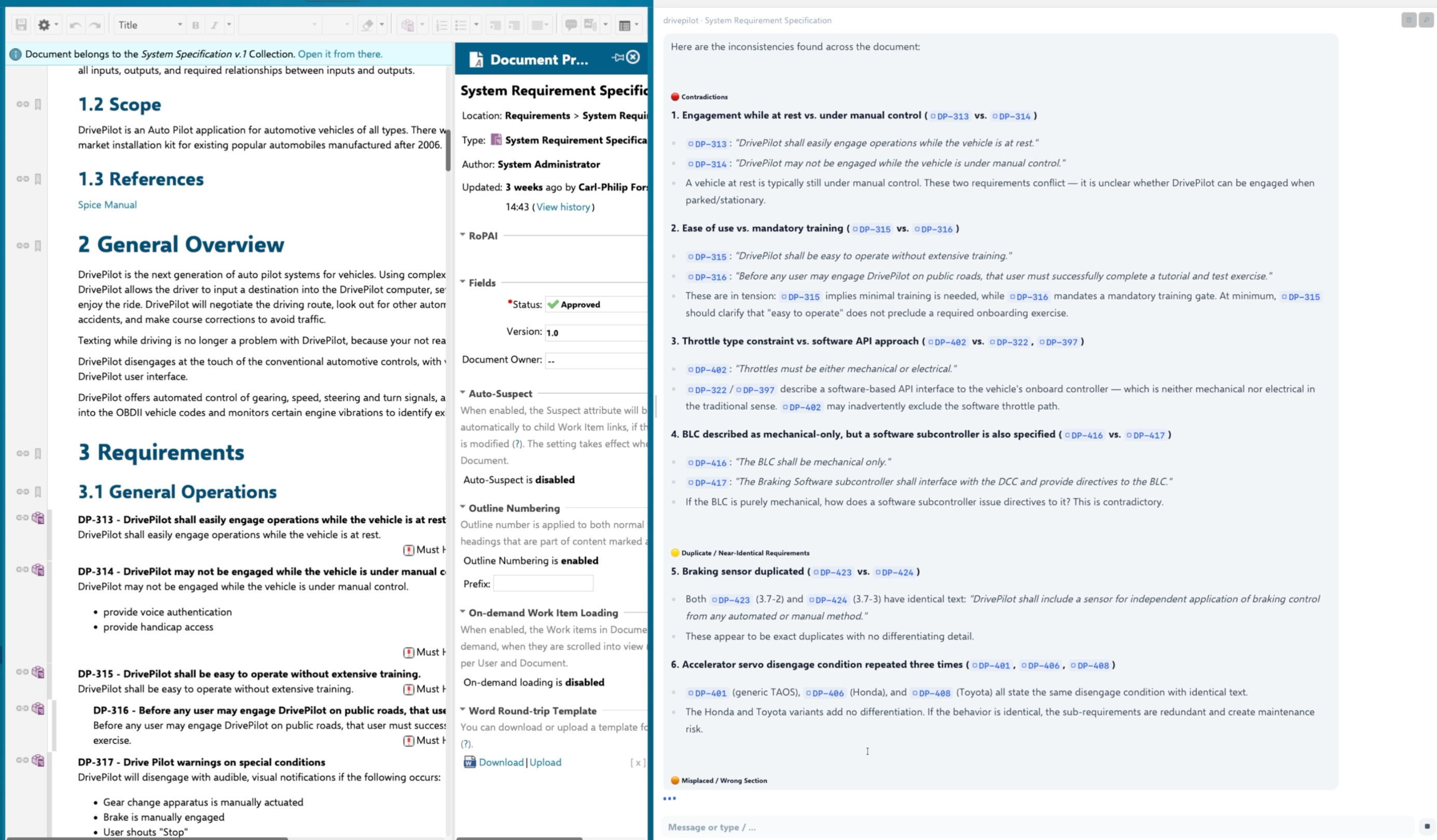
Ask RoP AI to list contradictions, ambiguous wording, or unsatisfied requirements in a document. Each finding is grounded in specific work items, with the original IDs cited so reviewers can act on them immediately.
Cited findings — every flagged issue points back to the work items that triggered it.
Formulation hints — get rewrite suggestions for vague or untestable requirement text.
Completeness checks — find parent requirements without children and children without parents in seconds.
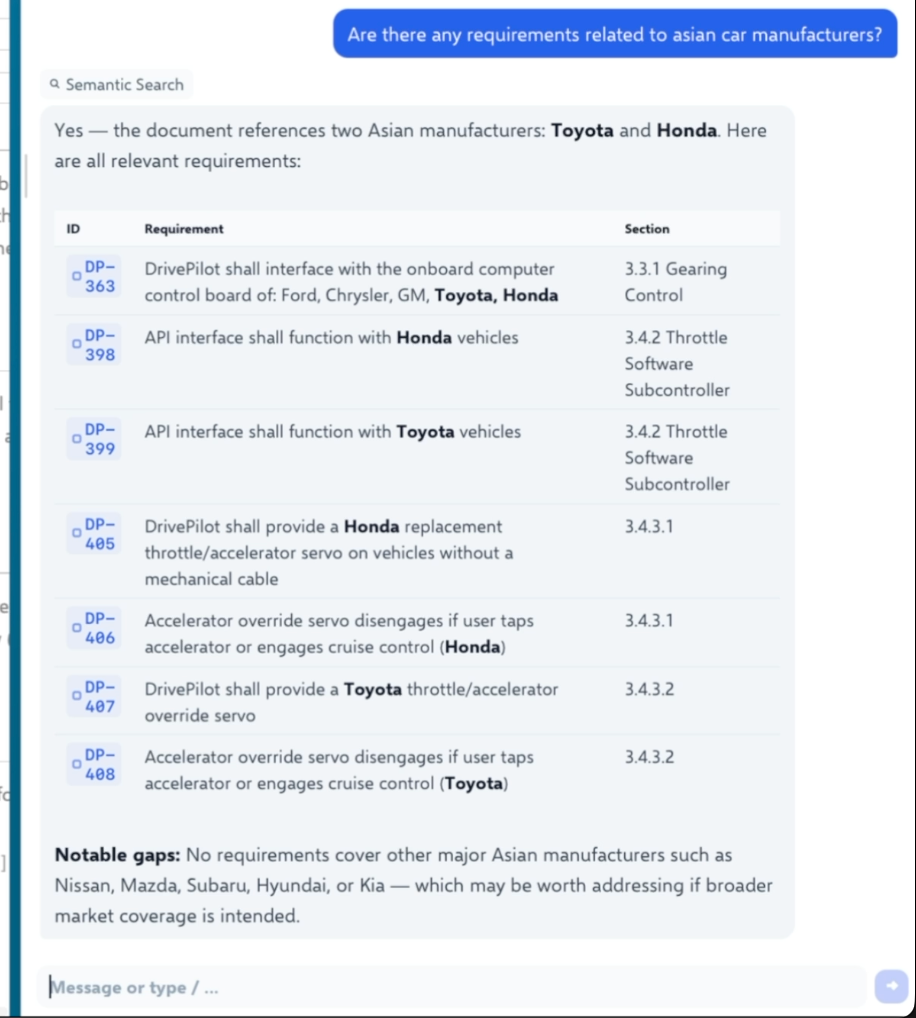
Find Requirements by Meaning, Not Just Keywords
A built-in vector store indexes your work items so RoP AI can answer questions like "are any requirements related to Asian car manufacturers?" — even when no exact keyword matches. Results include cross-project chips so related items surface no matter where they live.
Local embeddings — semantic indexing runs on your own infrastructure, your text never leaves your environment.
Cross-project results — duplicates and related work surface across project boundaries.
Document-scoped mode — narrow the search to a single document when you want a focused answer.
Built for Enterprise Polarion Deployments
RoP AI is designed to slot into existing Polarion governance — not work around it.
Token Pass-Through
The agent uses the logged-in user's own Polarion token. No service accounts, no shared credentials, no privileged access.
Per-User Permissions
RoP AI can only see what you can see. Project-level and item-level permissions in Polarion apply unchanged.
Self-Hosted Backend
Deploy the agent backend inside your own network via Docker Compose. Bring your own LLM provider — Anthropic, OpenAI, or Azure OpenAI.
Built for Real Requirements Work
RoP AI is designed for the day-to-day reality of authoring, reviewing, and maintaining requirements in Polarion.
Onboard New Engineers Faster
Ask "what is this document about?" and get a structured profile of the requirements, coverage, and outstanding gaps. New team members get oriented in minutes instead of days.
Refactor Requirements Without Surprises
Run an impact analysis before touching a high-level requirement. RoP AI walks the link graph and lists every downstream item that would need review — so scope discussions are grounded in evidence.
Audit-Ready Quality Sweeps
Have the agent comb through a document for inconsistencies, ambiguities, and unsatisfied requirements. Findings come with citations to the work items they reference.
Ready to put an AI engineer in every Polarion seat?
See how RoP AI turns natural-language questions into grounded, traceable answers — on your real Polarion data.